

A featured contribution from Leadership Perspectives: a curated forum reserved for leaders nominated by our subscribers and vetted by the Construction Tech Review Advisory Board.

ABI Research
Can Edge Computing Stimulate Novel Applications for Enterprise Customers?

Jake Saunders
Edge computing refers to a computing network topology where network functions that are typically located and grouped in central locations are moved and distributed closer to users (i.e., the network’s edge). An enterprise’s end users can, therefore, benefit from more versatile and capable cloud/data center applications as well as reduced latency. In other situations, an enterprise can achieve cost savings as end-user hardware complexity and processing are handed off to edge computing nodes.
Mobile Edge Computing (MEC)looks into placing typical data center servers, including computing, storage, and networking components, within a network’s radio access network domain. Typical sites include macro basestation locations as well as traffic routing/switching offices.
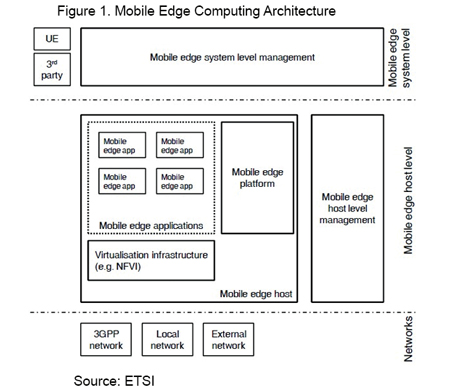
The MEC system consists of a number of hardware, software, and management elements required to create a virtualized environment. At the heart of the MEC architecture, there are three categories:
• The mobile edge host, which refers to the actual physical and logical components at the edge and is essentially the combination of the virtualization infrastructure and the application platform.
• The mobile edge system-level management, which manages a wider aspect of the MEC-based network.
• The mobile edge host-level management, which manages a specific host.
Mobile operators, MEC solution vendors, and application software developers have been developing and evaluating a number of edge computing application scenarios.
Video Stream Analysis
The main advantage of MEC, its local processing capability, is most prominent when used to analyze large quantities of video data. MEC enables video monitoring systems to do a more effective job at handling near-real-time video analysis near the camera location or by transmitting video to the core network, or even to the public cloud. By installing video processing applications at the edge, savings are achieved at both the content generation source and in the backhaul, guaranteeing low latency for video distribution.
Augmented & Virtual Reality
Augmented reality (AR) and virtual reality (VR) applications offer advanced methods for businesses and venues to advertise and promote information and new video experiences. AR applications rely on continuously analyzing a device's camera output, tracking the device’s movement and orientation in order to respond with the desired content in real-time. Combining local content caching and processing with device location tracking, the use of MEC is ideal for guaranteeing the delivery of the quality of service required for such services.
Enterprise Deployment of MEC
This use case mainly targets offices and corporate environments where workplaces are rapidly shifting from fixed desk structures to mobile cultures with the help of cloud-based software and various mobile devices like smartphones, tablets, and laptops as well as the now established culture of bring-your-own-device.
Implementing an IP-PBX through a MEC platform enables the seamless integration of in-building cellular networks into an enterprise’s WLAN network.
Connected Vehicles
Connected car systems can sense vehicle behavior and communications on the road and offer valuable notification and alerting services to increase safety and reduce traffic congestion. Connectivity can also enable new entertainment services and other value-added services like location finder and parking assistance. Deploying MEC in base stations or small cells along the road provides the required low latency. The MEC application directly receives the information from the vehicles and other road sensors, analyzes them, and transmits real-time messages to the vehicles while propagating the information to other neighboring MEC servers and the central cloud service for larger scale reporting.
IoT Gateway Service Scenario
Internet of Things (IoT) systems depend on a collection of connected devices and sensors that are served by a set of underlying networks including 3G and LTE and unlicensed technologies such as Wi-Fi, Bluetooth, ZigBee, RPMA, Sigfox, and LoRa. For various IoT scenarios, a MEC-enabled gateway is necessary to ensure that requirements for low latency responses are met by providing real-time aggregation and distribution services for the IoT devices locally. It can also provide analytics and decision logic based on analytic results.
At the edge, a considerable quantity of data is collected about users, network conditions, local context, and consumer behavior. Transmitting all this data to the core may be counterproductive due to high latency and wasted bandwidth. Hence, there is a solid case for deploying MEC in such scenarios. Analytics may include various activities, including but not limited to event correlation, big data applications, and machine learning.
Retail Customer Behavior Analysis
Traditional high street stores are looking for any competitive advantage they can attain over online retailers. Edge analytics—encompassing sales data, images, coupons used, traffic patterns, and videos generated and analyzed—provides unprecedented insight into consumer behavior patterns.
Healthcare
The healthcare industry is changing with the rise of the digital era. Devices such as Fitbits, telehealth tools, and glucose monitors are reshaping the sector completely. The data stored on these devices can be used to update a patient’s digital medical records; however, the existing cloud infrastructure cannot manage the amount of data they produce. Edge computing connects these medical devices, providing doctors and physicians with reliable and up-to-date patient monitoring information during medical emergencies and routine follow ups alike.
Summary Thoughts
Mobile Edge Computing is still going through proof of concept (PoC) demonstrations and limited customer trials by mobile telcos. However, the business case rationales are starting to mature, and mobile operators such as Telefonica, Orange, AT&T, and Verizon are moving beyond these PoCs and trials. Huawei, Nokia, Samsung, and ZTE are members of the official ETSI MEC group and are developing relevant products. However, enterprise and MEC specialists such as SpiderCloud (Corning), Quortus, and Vasona Networks are also jockeying for positions in the MEC market.
MEC can be deployed on 4G LTE architectures, but because MEC business models are relatively nascent it is likely MEC will develop alongside 5G. 5G will of course deliver additional enhancements for MEC, as it will further boost data throughput, reduce latency, and assure reliability.
Connected Vehicles
Connected car systems can sense vehicle behavior and communications on the road and offer valuable notification and alerting services to increase safety and reduce traffic congestion. Connectivity can also enable new entertainment services and other value-added services like location finder and parking assistance. Deploying MEC in base stations or small cells along the road provides the required low latency. The MEC application directly receives the information from the vehicles and other road sensors, analyzes them, and transmits real-time messages to the vehicles while propagating the information to other neighboring MEC servers and the central cloud service for larger scale reporting.
IoT Gateway Service Scenario
Internet of Things (IoT) systems depend on a collection of connected devices and sensors that are served by a set of underlying networks including 3G and LTE and unlicensed technologies such as Wi-Fi, Bluetooth, ZigBee, RPMA, Sigfox, and LoRa. For various IoT scenarios, a MEC-enabled gateway is necessary to ensure that requirements for low latency responses are met by providing real-time aggregation and distribution services for the IoT devices locally. It can also provide analytics and decision logic based on analytic results.
Analytics
At the edge, a considerable quantity of data is collected about users, network conditions, local context, and consumer behavior. Transmitting all this data to the core may be counterproductive due to high latency and wasted bandwidth. Hence, there is a solid case for deploying MEC in such scenarios. Analytics may include various activities, including but not limited to event correlation, big data applications, and machine learning.
Retail Customer Behavior Analysis
Traditional high street stores are looking for any competitive advantage they can attain over online retailers. Edge analytics—encompassing sales data, images, coupons used, traffic patterns, and videos generated and analyzed—provides unprecedented insight into consumer behavior patterns.
Healthcare
The healthcare industry is changing with the rise of the digital era. Devices such as Fitbits, telehealth tools, and glucose monitors are reshaping the sector completely. The data stored on these devices can be used to update a patient’s digital medical records; however, the existing cloud infrastructure cannot manage the amount of data they produce. Edge computing connects these medical devices, providing doctors and physicians with reliable and up-to-date patient monitoring information during medical emergencies and routine follow ups alike.
Summary Thoughts
Mobile Edge Computing is still going through proof of concept (PoC) demonstrations and limited customer trials by mobile telcos. However, the business case rationales are starting to mature, and mobile operators such as Telefonica, Orange, AT&T, and Verizon are moving beyond these PoCs and trials. Huawei, Nokia, Samsung, and ZTE are members of the official ETSI MEC group and are developing relevant products. However, enterprise and MEC specialists such as SpiderCloud (Corning), Quortus, and Vasona Networks are also jockeying for positions in the MEC market.
MEC can be deployed on 4G LTE architectures, but because MEC business models are relatively nascent it is likely MEC will develop alongside 5G. 5G will of course deliver additional enhancements for MEC, as it will further boost data throughput, reduce latency, and assure reliability.
The articles from these contributors are based on their personal expertise and viewpoints, and do not necessarily reflect the opinions of their employers or affiliated organizations.
